Myths vs Reality: How Content Recognition Shapes TV Ad Targeting
Myths vs Reality: How Content Recognition Shapes TV Ad Targeting
By Emily Carter
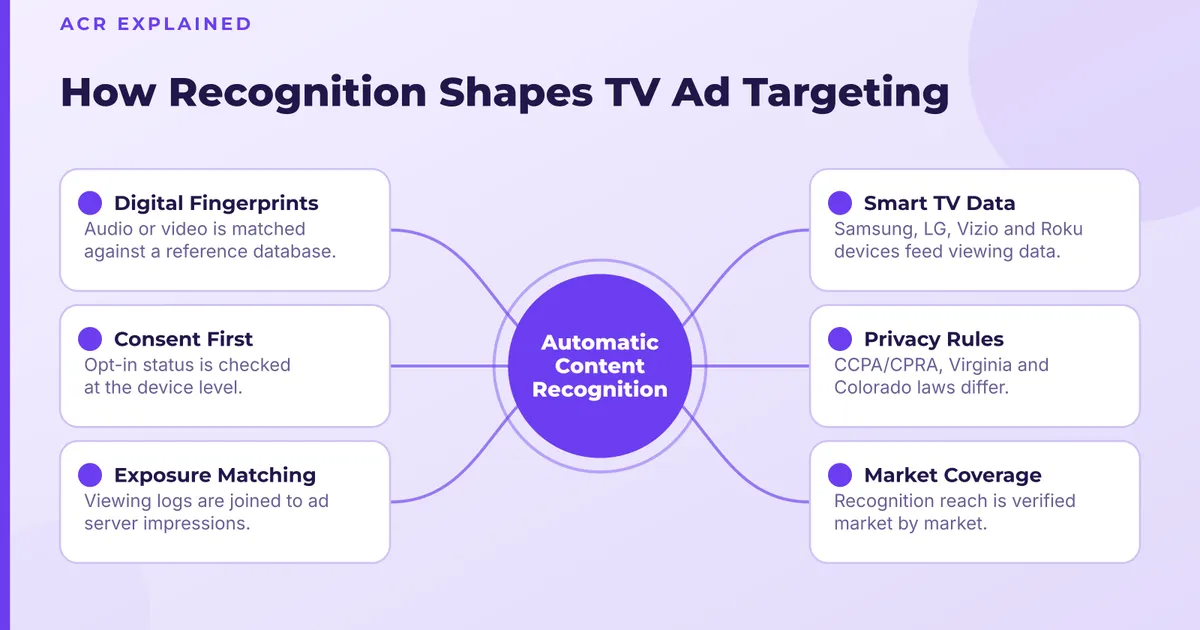
If you have ever wondered why a smart TV seems to know that you just finished a cooking show and then serves you a kitchen gadget ad, the answer is almost always automatic content recognition. Put simply, automatic content recognition (ACR) is software that identifies audio or video playing on a screen in near real time by matching digital fingerprints or watermarks against a reference database. In a typical US living room in Houston, a viewer can finish a cooking program on a Samsung, LG, or Vizio set and see a relevant kitchen ad within minutes, and that sequence is the result of ACR data flowing from the television to an advertising stack. For buyers of television ad inventory, streaming platforms, and connected TV teams working out of New York, Los Angeles, Chicago, and Houston, the technology has become the connective tissue between what people watch and what brands pay to show them.
This article is a practical walk-through for US ad operations teams who need to set up ACR-driven campaigns, the inputs they must have in place before launch, and the places where campaigns usually break down. It builds on the parent article's core point that recognition data, not demographic guesswork, is what makes the newer forms of TV targeting work. The scale is large enough to justify the effort: connected TV viewing in the US is a substantial share of total screen time, and CPMs on connected inventory in dense markets such as New York and Los Angeles typically sit well above those of many open-web placements, which means small targeting errors are expensive. Every dollar spent against a mismatched household is a dollar that a linear buy in the same market would have spent more efficiently on a broader audience, so the margin for error is narrow. For ad operations teams, the first practical step is to confirm that their data partners can deliver automatic content recognition signals at the household level before any campaign budget is committed.
Teams that build those habits now will be better positioned as state privacy rules keep tightening and as connected TV inventory continues to grow
- Counting ACR impressions as viewable without verifying on-screen exposure inflates reported reach, and overlapping campaigns that share a household pool quietly multiply frequency
- Recognition signals are only as good as the matching logic behind them, and teams that do not review their vendor's error rates tend to discover problems only after a flight has underperformed
- During the flight, the team should settle ACR logs against ad server data daily, monitor opt-outs by state and device, and rotate creative according to content category performance
- Consent and data access come first, measurement comes second, and the discipline of reviewing results against a linear control comes last but determines whether the next campaign is better than the one before
What You Need Before Launch
The first requirement is access to ACR data with real US smart TV coverage. That means a supply partner or data vendor whose recognition footprint spans the major manufacturer platforms, including Samsung, LG, Vizio, and Roku devices. Coverage should be checked market by market rather than accepted as a national headline number. A vendor may have strong reach in the Chicago metro and thin reach in parts of Houston, and a campaign built on the national figure will misallocate spend in exactly the places where the budget is largest.
The second requirement is a consent framework that can be defended in an audit. Opt-in status differs by device and by household, and it must be respected at the device level before any segment is built. US teams also have to account for state privacy statutes, most visibly the California Consumer Privacy Act as amended by the CPRA, along with the Virginia and Colorado privacy laws. These statutes differ on what counts as sale or sharing of data, what retention periods apply, and what consumers can request. A single national policy written against one state's rules is a common source of exposure.
The third requirement is a measurement stack capable of joining viewing logs to exposure logs. Without a clean-room or attribution layer that can match recognition events to ad server impressions, the team cannot tell whether an ACR-targeted household actually saw the creative. The fourth is a budget baseline. Teams should pull current ACR CPMs in dollars for each target market, confirm minimum commit thresholds, and compare them against linear alternatives for the same audience, so that the business case is grounded in numbers the buyer has verified rather than assumed.
Execution Sequence
Audience definition should start from viewing categories such as cooking, sports, or news, not from someone identities. Category-level segments are both more defensible under privacy rules and more useful for creative matching, because the content a household watched in the last hour is a stronger signal of intent than a static profile. Once segments are set, the creative team maps variants to those categories and sets frequency caps at the household level so that a single household is not hit repeatedly across overlapping flights.
Trafficking then runs through a demand-side platform with ACR inventory flags enabled, which lets the buyer restrict bidding to recognized connected TV impressions and exclude the rest. Timing should follow US seasonality. Holiday retail campaigns peak in the weeks before Thanksgiving through December, NFL season drives sports and beverage categories from September through early February, and the back-to-school window pulls family and apparel budgets into late July and August. Launching a cooking-category flight during the NFL season without adjusting creative or caps is a predictable way to waste impressions on households whose attention has shifted.
What to Monitor Once Live
The most useful early signal is the match rate between ACR logs and ad server impressions. A low match rate usually points to a tagging or pixel problem rather than a targeting problem, and it should be diagnosed before the team draws any conclusion about performance. Viewability and completion rates on connected TV should be compared against linear placements for the same creative, since differences in completion are often the clearest evidence that the recognition signal is improving the audience rather than merely narrowing it.
Frequency distribution deserves close attention in dense markets like Chicago and Houston, where overlapping campaigns from several advertisers can stack on the same households. Opt-out rates should be tracked by state and by device manufacturer, because a rise in opt-outs in one state can signal a consent prompt change or a regulatory shift rather than a creative problem. A daily reconciliation between ACR logs and ad server data is the practical way to catch these issues while the flight can still be corrected.
Choosing and Vetting ACR Data Partners
Vendor selection should turn on criteria that change outcomes. Household coverage by designated market area is the first, because a national total can hide gaps in the markets where the buyer's revenue is concentrated. Recognition latency and accuracy matter next, and they behave differently for live sports, which is time-sensitive and widely watched, and for time-shifted content, where the recognition window can be longer and the match confidence lower. Data governance is the third criterion, covering retention periods, deletion workflows, and whether the vendor can produce state-level compliance documentation on request. Teams that have already tested recognition-based buying often find it useful to document their setup in a shared checklist, since common mistakes tend to repeat across campaigns when the same assumptions about match rates and refresh timing go unchecked.
A useful checklist asks whether the vendor reports match rates by DMA, including New York, Los Angeles, Chicago, and Houston, rather than only in overall. It also asks whether sensitive content categories can be excluded from targeting, whether pricing is stated in dollars per thousand impressions with no hidden data fees layered on top, and whether independent audits of accuracy claims are available. A vendor that cannot answer these questions in writing should not be trusted with a live budget.
For teams that want a neutral reference point on the mechanics before they start vendor conversations, a short primer on automatic content recognition helps align internal stakeholders on the terms, which matters because the words fingerprint, watermark, and match rate are often used loosely in procurement meetings.
Where Teams Commonly Go Wrong
Consent and compliance failures are the most expensive mistakes. Teams often assume that a national opt-in rate applies uniformly to every state, when the consent flows, data definitions, and retention rules differ enough that a single policy will be wrong somewhere. They also fail to track amendments to state privacy statutes that change how data may be retained or sold, so a policy that was compliant when the campaign was planned can become non-compliant mid-flight.
Measurement errors follow closely. Teams that rely on a single attribution model without reconciling it against linear control groups tend to overstate the value of recognition-based targeting. Creative and budget misallocation rounds out the list: generic creative run across every content category wastes the context advantage that ACR provides, and overspending in premium markets without testing secondary DMAs leaves cheaper, reachable audiences unexplored.
Another recurring error is treating ACR as a finished product rather than a data input. A short audit at the midpoint of each flight, comparing predicted segment membership against a sample of verified viewing, catches drift before it turns into wasted budget.
Operational Checklist for US Campaign Teams
Before launch, the team should confirm that consent verification is complete for every target state, that the vendor's match-rate and accuracy reports have been reviewed by DMA, and that frequency caps are set at the household level. After the campaign ends, the analysis should break attribution down by market, report cost per outcome in dollars against the linear baseline, and archive documentation so that any compliance audit can be answered without reconstructing the record from memory.
The sequence is the same whether the buy is a regional test in Houston or a national push across New York, Los Angeles, and Chicago. Automatic content recognition gives US advertisers a far more precise view of what households watch, but that precision only pays off when the consent framework, the vendor vetting, and the post-campaign analysis are treated as part of the buy rather than as afterthoughts.