Pre-Sea Checklist: What to Prepare Before Starting Your Deck Cadet Career
Pre-Sea Checklist: What to Prepare Before Starting Your Deck Cadet Career
By Michael Harrington
Every week, thousands of people who want to go to sea begin with the same search, and the first useful step is to understand what a deck cadet berth actually demands before you spend time on applications. The role sits at the foot of the officer track, and the prerequisites you bring to the table decide whether your application ever reaches a crewing manager's desk. The guide that follows builds on that starting point, moving from the requirements to the application sequence, then to the criteria for judging an offer, and finally to the mistakes that quietly derail otherwise capable candidates. Platforms such as SeaJobs.pro, a global platform for seafarers and crewing companies, publish vacancies with stated salary, vessel type and joining dates, so the comparison framework below can be applied to real postings rather than abstract ones. Where the source material on vacancies, verification and pay has already been set out, this article expands on it with the practical detail a first-time applicant needs.

What You Need Before Applying for a Deck Cadet Berth
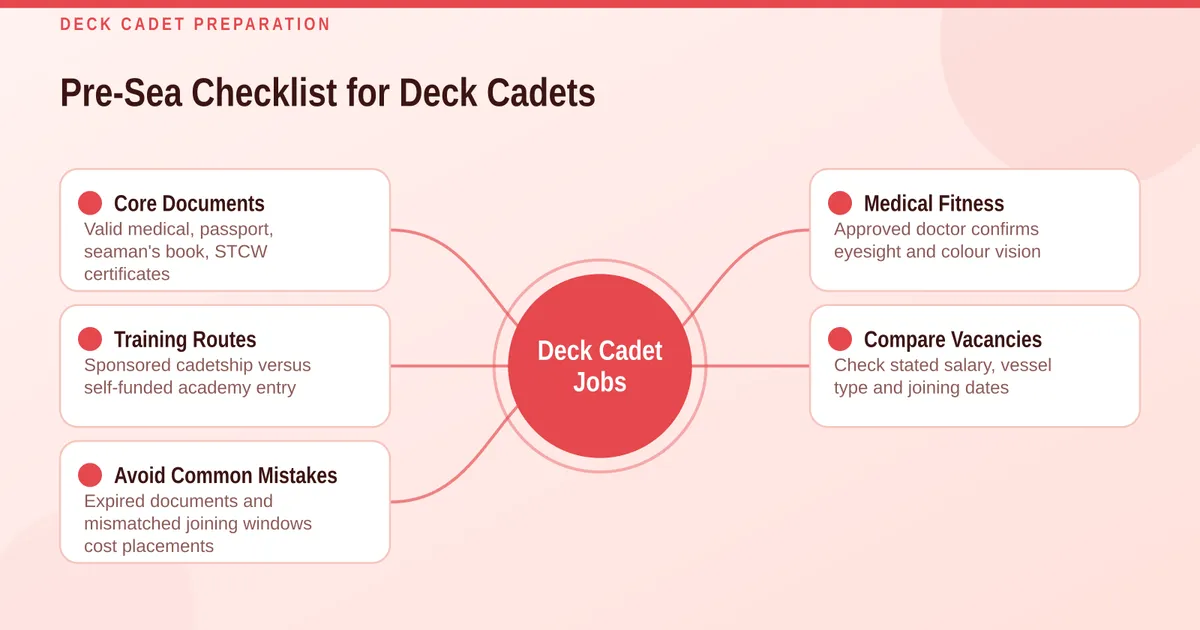
Before any vacancy is worth your time, your documents must be in order, because an application with a missing or expired item is usually rejected at the first screening rather than reviewed on its merits. The core prerequisites are a valid seafarer medical fitness certificate, a passport with enough remaining validity for the voyages you are likely to join, a seaman's book or equivalent identity document, and STCW basic safety training certificates. Most employers also expect a secondary school diploma with a solid grounding in mathematics and physics, since navigation, stability and cargo calculations are assessed from the first day of the cadetship. Check each expiry date against your intended joining window; a medical certificate that lapses a few weeks after your start date can cost you a placement that was otherwise agreed. Browsing deck cadet jobs is a practical way to see which companies are currently recruiting trainee deck officers and what contract durations and rank requirements they set.
Independently verify the employer and the vacancy, checking flag state, agency registration and the named principal rather than relying on the advertisement alone
- Candidates also frequently pay upfront fees to unverified agencies, believing that a fee is a normal part of the process
- Self-funded training costs are often underestimated, particularly the expense of exam resits and currency fluctuations between the wage currency and the currency of study
- Poor logbook discipline, where duties are recorded vaguely or late, can make sea-time difficult to certify
- Compare salary, leave and repatriation terms in writing across every offer, and calculate total monthly income rather than trusting the headline figure
The medical examination deserves particular attention because it is the requirement most often misunderstood. The certificate must be issued by an approved doctor and must confirm fitness for seagoing duties, including eyesight, colour vision and hearing standards. Colour vision is tested because deck officers must identify navigation lights, signal flags and cargo markings reliably. Swimming ability is commonly requested as a separate confirmation, and some employers require it in writing. Bring the original certificate and keep a scanned copy in a clearly named folder, because agencies will request it at multiple stages of the process.
Training pathways determine how you enter the cadet grade, and the two main routes carry very different financial and contractual implications. A sponsored cadetship means a shipping company or manning agency pays for your academy fees, often provides a wage during training, and guarantees sea-time on its vessels under a signed agreement. Self-funded entry through a maritime academy gives you more freedom to choose your employer later, but it places the full cost of tuition, uniforms, exam fees and travel on you. Compare the two routes by adding up every expense on the self-funded side, including accommodation during study, examination resits and the cost of your initial equipment kit, and then weigh that total against the value of a guaranteed berth. A sponsored contract is only as good as its written terms, so read the clauses on repayment if you leave early, because some agreements oblige the cadet to reimburse training costs.
Personal readiness is the factor that applicants underestimate most often. A deck cadet works long watches, shares tight accommodation with crew from different countries, and may spend several months without a port visit or contact with family beyond limited satellite connectivity. Realistic preparation means asking yourself how you handle confinement, whether you cope with irregular sleep patterns, and how you respond when a contract runs longer than planned. Recruiters value candidates who can state these expectations plainly during interview, because the ones who have thought them through are far less likely to leave a placement after the first rotation.
The Application Sequence: From Shortlist to Joining Date
The application process follows a predictable order, and understanding that order lets you prepare the right document at the right moment rather than sending everything at once. You start by sourcing vacancies, then verify the employer, then assemble your package, then pass interview and assessment stages, then sign the contract, and finally confirm the joining date and logistics. Each stage can stall if the previous one was incomplete, which is why a disciplined approach saves weeks. Many applicants lose their place in a queue simply because they responded slowly to a document request or sent a CV that did not match their certificates.
Sourcing legitimate postings requires looking in the places where real employers recruit. Company career pages, established manning agencies, maritime academy job boards and recognised seafarer platforms all publish genuine cadet openings. The warning signs in a job advertisement are consistent: a demand for an upfront fee before any interview, a vessel described only as "a bulk carrier" with no name, flag or trading area, and no visible company registration or address. Verify the employer by checking that the vessel's flag state matches the contract, that the agency can produce its registration and that its named principal is a real shipping company. A legitimate agency will answer these questions without hesitation, and an agency that avoids them is telling you how it will behave once you are at sea.
Your application package should be built around clarity and verifiability. A deck cadet CV should list certificates by name and number, state any sea-time already gained by vessel type, and highlight evidence of physical fitness, teamwork and navigational aptitude. A reference from a school teacher, a sports coach or a volunteer organiser adds credibility when you have no prior sea-time. Tailor a short cover letter to the specific vessel type or trading area named in the vacancy, showing that you understand what a tanker cadet or a container ship cadet is expected to do each day. Attach copies of key documents in the format the agency requests, usually PDF, and name each file so the recruiter can locate it without searching.
Interviews and assessments test both technical knowledge and character. Typical questions ask why you chose a deck career, how you would respond to a fellow crew member who refuses a safety instruction, and what you would do if you noticed a defect in mooring equipment during your watch. Answer scenario questions by describing the specific steps you would take, in order, rather than offering general statements about teamwork. Aptitude and psychometric tests usually measure numerical reasoning, spatial awareness and response to pressure, and they are designed to reveal how you think rather than what you have memorised.
Reviewing the cadet contract before signing is the step where experienced seafarers protect their income. Read the probation period and the conditions under which it can end, the wage scale and how overtime and allotments are calculated, the leave entitlement, and the repatriation terms, including who pays and in what circumstances. Confirm the notice period for leaving and check whether the contract references a recognised seafarers' employment agreement or collective agreement where one applies. If any clause is unclear, ask for it in writing before you sign, since verbal assurances carry little weight once you are at sea.
Confirming the joining date and logistics closes the sequence. Read the joining instructions carefully, noting the port of joining, the required arrival time and the name of the contact who will meet you. Build a pre-joining checklist covering visas where needed, flight bookings, the equipment kit list supplied by the employer and any medical or vaccination records the port authority may request. Joining dates slip for many reasons, from vessel delays to documentation problems, so keep your availability flexible for a reasonable period and ask the agency to confirm any change in writing. Before committing to any offer, it helps to check what to look for in a posting, such as the vessel type, the required certificates, the stated pay structure and the exact joining port.
Evaluating an Offer: Criteria Checklist
Once offers begin to arrive, the decision should rest on a structured comparison rather than on the advertised salary alone. The most useful approach is to score each offer across four areas: pay and benefits, training quality, vessel and trading pattern, and the reputation of the employer. Writing these scores down side by side prevents the most attractive headline figure from distorting your judgement. The framework below is designed to be applied to any vacancy listed on a platform such as SeaJobs.pro, where salary, vessel type and joining date are stated for each posting.
On pay, start with the basic wage and then calculate the total monthly income under a realistic watchkeeping schedule. Note the currency, because a wage paid in one currency and spent in another carries exchange exposure, and check how overtime is calculated and whether it is guaranteed or discretionary. Leave pay may be calculated on the basic wage only, and allotments to family are usually deducted from the net. Some contracts also deduct uniforms, travel reimbursements or medical costs. An offer with a lower gross figure but full overtime guarantees and clear leave pay can produce a higher take-home amount than a higher gross offer with discretionary extras.
Training quality determines how much your sea-time is worth in the certification process. Ask whether the company provides structured training records, whether a named mentor will supervise your logbook entries, and how often the master or chief officer reviews your progress. Vessel type and trading pattern matter here as well: a cadet on a vessel with frequent cargo operations and busy navigation gains exposure to the tasks required for certification more quickly than one on a fixed short-sea route with little deck work. The officer-to-cadet ratio on board also affects how much individual attention you receive, and it is worth asking directly.
The reputation of the company and vessel is the area where diligence pays the highest return. Inspection records and any history of detentions give a clear indication of safety culture, and a company that cooperates openly with port state inspections is generally a safer employer. Ask how crew feedback is handled, whether there is a confidential channel for raising concerns, and what the crew retention rate looks like. Confirm whether union or collective agreement coverage applies, since that coverage often determines the strength of your wage and repatriation protections.
Common Mistakes That Derail Cadet Careers
Most failed cadet placements trace back to a small set of predictable errors, and each one is avoidable with preparation. The first group concerns documentation. Expired or mismatched certificates cause rejected joinings more often than any other single factor, and incomplete sea-time records delay certification later in the career. In legitimate recruitment, the employer or a verified agency bears the cost of placement, and an agency that demands money before any contract is signed should be avoided.
The second group concerns the contract and finances. Signing without reading the probation and termination clauses leaves you exposed if the placement ends early, and it is common for cadets to discover too late that repatriation costs fall on them. Leave and repatriation terms should be understood before departure, not after a dispute has already begun.
The third group appears after joining. Weak communication with mentors, or unrealistic expectations about how quickly responsibility will be given, frequently leads to frustration and early departure. The most effective cadets plan the next stage from the start, mapping their sea-time against the requirements of the examinations that lead to third officer and treating each rotation as a documented step toward that goal.
Final Decision Checklist and Next Steps
A deck cadet berth is the first measurable step on the officer's ladder, and the decisions you make in the application phase shape the training and earnings that follow. Before you send your first application, confirm that every document is valid and that your medical certificate covers your intended joining window. Finally, map your training and sea-time plan to the certification you intend to achieve, so that each rotation moves you forward rather than simply filling time. Applicants who approach the process this way tend to secure placements faster, sign better contracts and build a career on firmer ground.