What Should Advertisers Check Before Choosing a Content Recognition Vendor?
What Should Advertisers Check Before Choosing a Content Recognition Vendor?
By Emily Carter
If you have ever wondered how a smart TV seems to know that you just finished a cooking show and then serves you a kitchen gadget ad, the mechanism is almost always automatic content recognition. In practical terms, it is software that identifies audio or video playing on a screen in near real time by matching digital fingerprints or watermarks against a reference database. For connected TV teams in New York, Los Angeles, Chicago, and Houston, this signal has become one of the main levers for targeting household-level ads, and the US market is where much of that budget now sits. The question that matters for a media buyer or ad operations lead is not whether the technology works in principle, but how to set up an ACR-based campaign from scratch and where such setups usually fail.
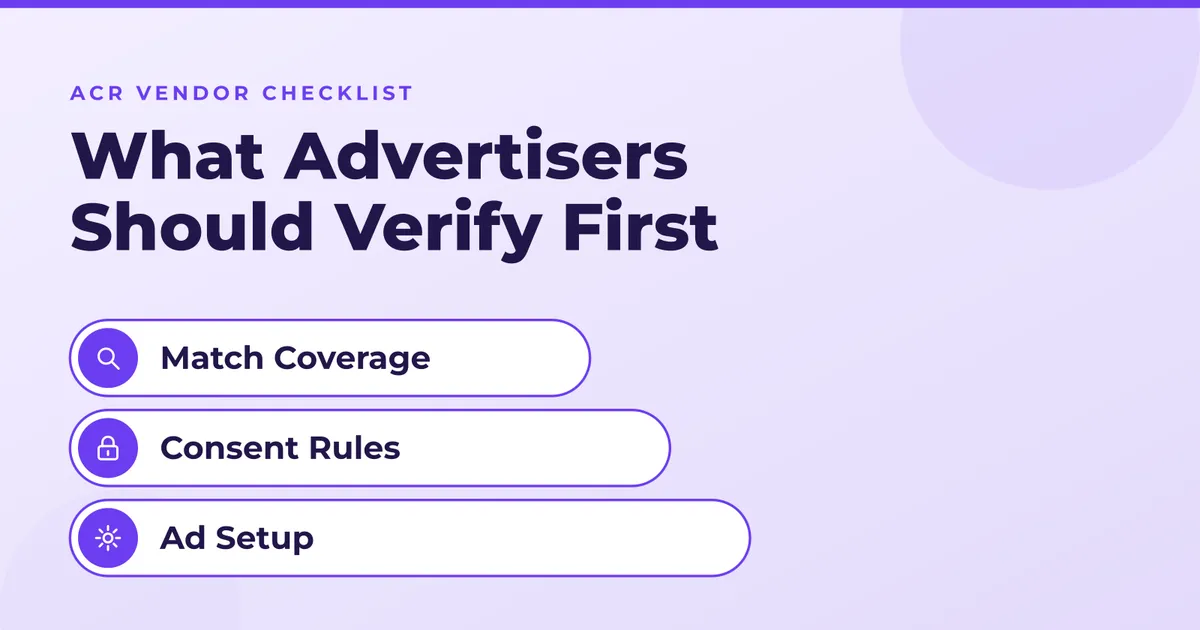
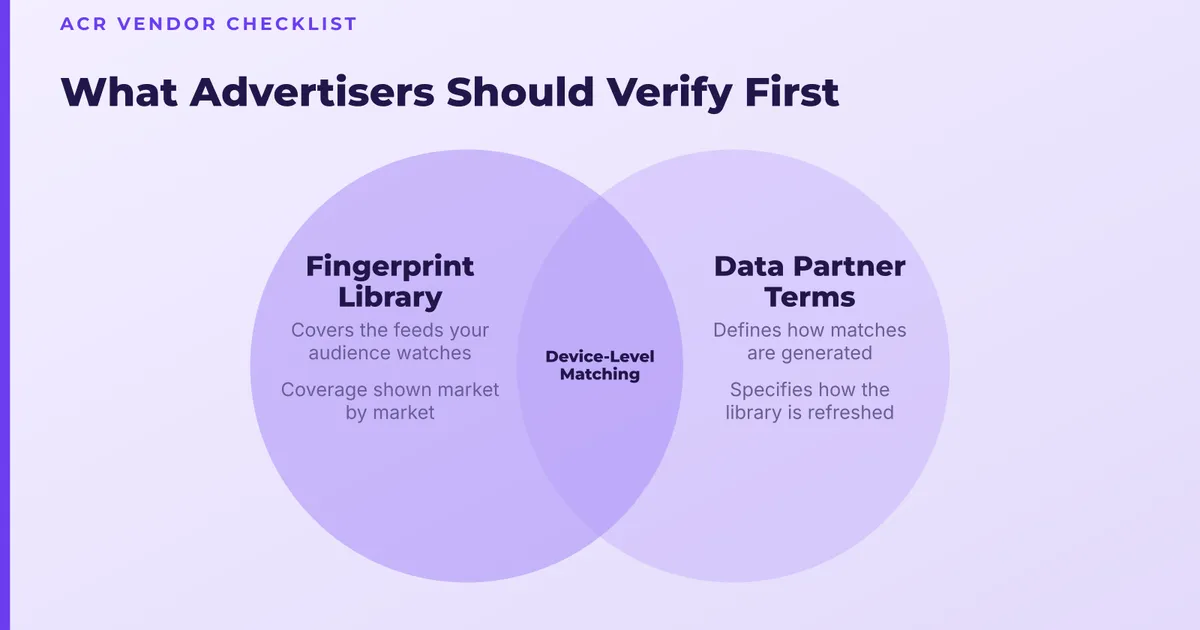
The short answer is that ACR turns passive viewing into a targetable data stream. When a viewer watches a program, the TV compares a small sample of the audio or pixels against a library of fingerprints built from national and local broadcast feeds, then reports the match to the platform along with a timestamp and device identifier. The reference library is what separates a useful signal from noise, because a fingerprint of a national news broadcast in Chicago will not match a regional sports feed in Houston unless the library has been built to cover both. This is why the first decision in any test is not creative or bidding, but which fingerprint sources and data partners you can actually rely on. The parent article on this topic made the same point from the other direction: the value of recognition depends on the quality of what it is matched against.
The advantage holds only when the reference data is sound, consent is handled correctly, segments are validated locally, and lift is measured against a control
- A holdout set aside before launch, matched on the same segment criteria, is the only reliable way to attribute lift
- Ask for the confidence thresholds the partner uses and the method by which they were validated, and treat a vendor that cannot explain either as a risk
- Define in advance what counts as a successful test, so the result is not reinterpreted after the fact
- Teams that build those four elements into the setup before spending tend to get reliable results, while those that start with activation and add measurement later usually end up unable to say what the campaign achieved
What you need before launching an ACR campaign
The data requirements come first. You need an ACR-enabled device panel large enough to produce reliable household counts in your target markets, data partner agreements that specify how matches are generated and refreshed, and a reference fingerprint library that covers the broadcast and streaming feeds your audience actually watches. A panel that is strong in Los Angeles may be thin in rural Texas, so the coverage check should be done market by market rather than accepted as a national figure. Ask partners to show match coverage by metro, not only in aggregate.
Budget and team structure determine how far a test can go. In the US, a regional pilot commonly starts in the range of $25,000 to $100,000 once data fees, platform minimums, and measurement are included, though the exact figure depends on the partner and the inventory you buy. Most teams need an analyst who can read match logs, an ad operations person who can configure segments in the DSP, and either an agency or a measurement partner who can design a holdout. Running the whole thing in-house is possible for large buyers, but smaller teams typically underestimate how much time goes into reconciling device data with campaign data.
Legal and consent groundwork is the third prerequisite, and it is more demanding in the US than many buyers expect. There is no single federal rule governing ACR viewing data, so the practical baseline is a combination of platform terms, the device-level opt-out that manufacturers provide, and state privacy statutes. California's CCPA as amended by the CPRA sets specific requirements for how personal information is collected, disclosed, and opted out of, and other states have adopted their own variants. Before launch, confirm that privacy notices reflect viewing-data collection, that the opt-out mechanics work on each device family in your panel, and that consent is captured at the device level rather than assumed from a general terms-of-service acceptance.
Step-by-step setup of an ACR-based campaign
Audience segmentation is where the abstract data becomes buyable. Program categories are mapped to segments: news viewers in Chicago, sports viewers in Los Angeles, and lifestyle or cooking audiences that can be targeted nationally. Keep segments narrow enough to be meaningful but broad enough to clear minimum audience thresholds in the DSP. A segment built on a single program title in one metro often produces a reach figure too small to bid on consistently, which is a common reason campaigns stall in week one.
Frequency, dayparts, and seasonality need to be configured together rather than one at a time. Football season produces sharp viewing peaks on Sunday afternoons and Monday nights, the holiday retail window pushes category spend into late November and December, and back-to-school shifts family viewing patterns in August and September. Frequency caps should reflect the fact that a household may watch the same program several times a week, so a cap that works for a broadcast daypart can over-serve an ACR audience that is defined by repeat viewing. Set dayparts against local time zones, since a campaign that treats Central and Pacific viewing as identical will misallocate spend in the evening block.
The final configuration step is connecting ACR signals to the demand-side platform and ad server. The data flow runs from fingerprint match to household segment, then to the bid stream, and the latency between those steps determines what you can target. Live viewing can be matched and activated within a short window, but the tolerance is tighter than for on-demand content, where the segment can be built from a longer history. Test the pipeline with a small volume before scaling, and confirm that the timestamps in the match log align with the impression timestamps in the ad server, because a clock mismatch of even a few minutes will silently break frequency and attribution.
What to watch during execution
Match accuracy and false positives are the first things to monitor once a campaign is live. Every fingerprint system has a confidence threshold, and raising it reduces false matches but also shrinks reach, while lowering it widens reach at the cost of waste. The right setting is found by testing against a sample where the viewed content is known, not by accepting the vendor default. Track the rate at which matches are later contradicted by panel data, since that rate is the clearest indicator of how much spend is going to the wrong audience.
Coverage gaps appear along device lines. Smart TVs from different manufacturers handle ACR differently, streaming sticks and game consoles report through their own pipelines, and cable set-top boxes may deliver viewing data through the operator rather than the device. In a typical US household these sources coexist, so a campaign that looks strong on one device family can be weak on another. Break reporting out by device type and check whether the households reached through one source are representative of the target population.
Reporting needs to cover exposure, household reach, incremental lift, and cost against CPM benchmarks, all expressed in dollars. Exposure and reach tell you whether the segment is delivering, while lift tells you whether those exposures changed behavior. CPM comparisons should be made against the buyer's choice inventory on the same platform, not against a general market average, because the cost of ACR-targeted impressions is driven by segment size and competition in the specific metro. Before committing to any vendor, it helps to understand how automatic content recognition works in practice, since its accuracy depends heavily on the quality of the reference fingerprints and the timing of the matching process.
Where practitioners most often go wrong
Treating match rate as reach is the most frequent error. A high match rate means many of the devices in a panel are reporting viewing data, but that share can differ sharply from the share of target households. If the reporting devices skew toward one brand or one region, the reach number will look healthy while the audience is unrepresentative. Compare the demographic and geographic profile of matched households against the target definition before reporting results upward.
Ignoring regional program differences causes segments to fail quietly. A national segment built on a program that airs at different times in Houston than in New York will show weak delivery in the markets where the schedule diverges. Local broadcast schedules, sports blackouts, and regional news lineups all affect what gets matched, so segments should be validated metro by metro. A segment that performs in Chicago may need separate definitions for Los Angeles.
Weak consent and disclosure handling creates risk that outlasts a campaign. Launching without updated privacy notices, or without working opt-out support at the state level, exposes the buyer to compliance issues that are costly to unwind. The same applies when device-level opt-outs are not honored across the panel. These checks are not optional extras; they belong in the launch checklist alongside creative approval.
Measurement without a control group is the most common reason lift claims fail under scrutiny. Without a holdout, there is no way to separate the effect of the ad from the household's baseline viewing and purchasing behavior. Teams that skip it tend to report exposure as if it were outcome.
Practitioner checklist and selection criteria
When evaluating a data partner, confirm that the fingerprint sources are transparent and that US coverage is documented by metro rather than asserted nationally. Privacy compliance should be mapped explicitly to CCPA and CPRA requirements and to any other state rules that apply to your audience, with a named owner for opt-out handling.
Before spending on activation, agree on a measurement plan that includes a holdout group and ROI targets expressed in dollars. A realistic rollout starts in one metro, Chicago being a reasonable example because its broadcast mix is broad, then expands to Los Angeles and Houston only after match accuracy and coverage have been checked in the first market. Scale in steps tied to measured results, not to the calendar.
Used this way, automatic content recognition gives US buyers a targeting signal that is tied to what households actually watch, which is the core difference from demographic proxies. The practical path is to fix the data and compliance foundation first, test in a single metro with a holdout, and expand only once the numbers hold up.